
East vs. West
War with Persia, and Herodotus at the dawn of history

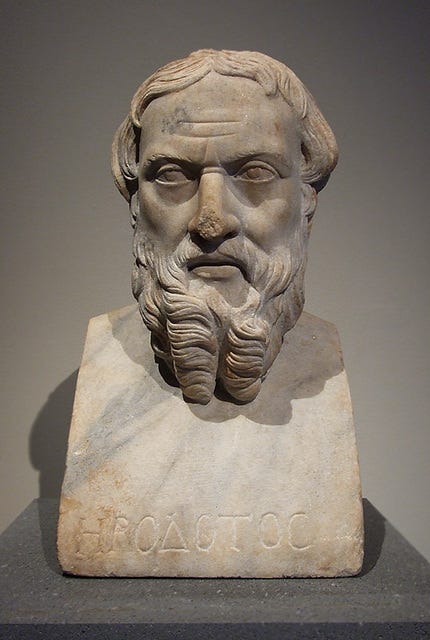
As the US and Iran engage in intermittent warfare, the opening of the first written work of history, Herodotus’s Histories, comes sharply to mind. A generation after Persian Wars (the series of Greek-Persian conflicts of 490-479 BC) Herodotus showed how that major conflagration echoed previous episodes of East-West conflict going back to mythical times, above all to the Trojan War waged between peoples of Greece and Asia as narrated in Homer’s Iliad.
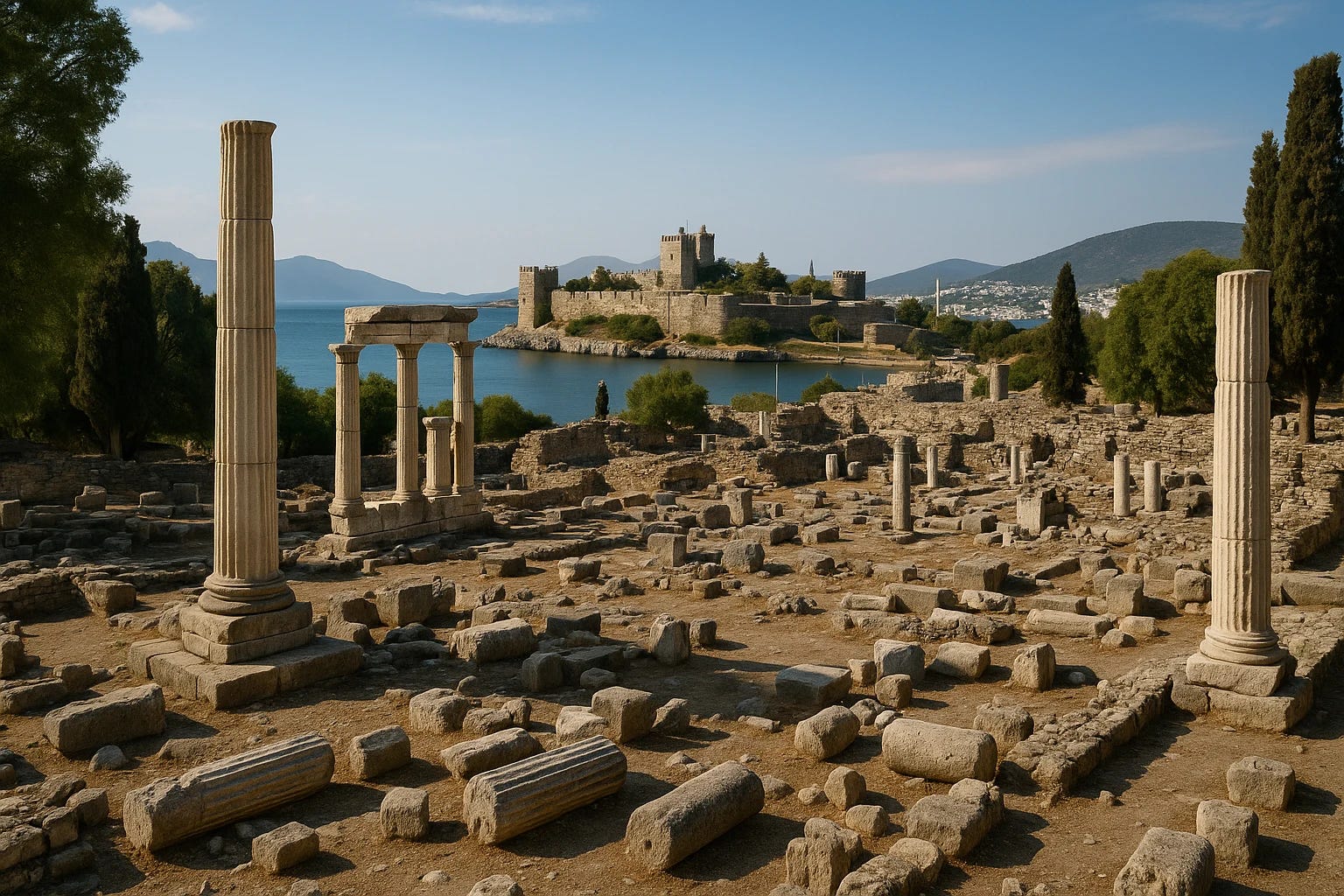
Herodotus’s magnificent 9-book work, published around 430 BC, initiated the idea of empirical, source-based historical investigation. The word historiê in Greek means ‘inquiry’; we still use the word in that sense, as in ‘natural history’, the investigation of nature. The introduction to the Histories is a long, rolling programmatic sentence, in which Herodotus names himself and speaks of a ‘presentation’ of his inquiry; he was said to have presented passages to audiences in oral form. He identifies his home city as Halicarnassus in Asia Minor, now Bodrum in Turkey, located between mainland Greece across the Aegean and the non-Greek world in the Asian hinterland. A century later the philosopher Aristotle recorded a different text of the opening, attributed to “Herodotus of Thourioi”: Thourioi was a new Athenian settlement in southern Italy, founded in 443 BC, where the historian settled for a while as a citizen before returning to Athens.
Herodotus thus wrote from the vantage point of someone neither wholly Greek nor wholly Asian, whose perspective and experience spanned the world of his time. He set out not only to give both sides their due - his word ‘unsung’ (aklea) echoes the Homeric kleos, ‘glory’ or ‘renown’ - but in particular to trace the cause of the Persian Wars, his account of which spans the last five books. I translate and read here:
      A presentation of the inquiry of Herodotus of Halicarnassus is here set forth
          so that what human beings have done may not be obliterated by time
and that great and wonder-worthy deeds performed by both Greeks and non-Greeks
may not go unsung and above all the cause of the war they waged with one another. Ἡροδότου Ἁλικαρνησσέος ἱστορίης ἀπόδεξις ἥδε
ὡς μήτε τὰ γενόμενα ἐξ ἀνθρώπων τῷ χρόνῳ ἐξίτηλα γένηται
μήτε ἔργα μεγάλα τε καὶ θωμαστά τὰ μὲν Ἕλλησι τὰ δὲ βαρβάροισι ἀποδεχθέντα
ἀκλεᾶ γένηται τά τε ἄλλα καὶ δι’ ἣν αἰτίην ἐπολέμησαν ἀλλήλοισι.
I’m reading Aeschylus’ The Persians at the moment. And really enjoying the dramatic portrayal from the Persian perspective. Aeschylus had an advantage in that he was there at the time. We simply don’t have enough of these accounts. We are the poorer for it.
I really like how you place Herodotus inside the mixed world of Halicarnassus rather than treating him as the spokesman for a sealed Greek West. What do you make of Aeschylus’ Persians? It seems to me that, before Herodotus transformed the war into history, and gave is some nuanced and often admirable depictions of Persians, Aeschylus had already adapted the war to the tragic "stage," giving the defeated enemy a voice and making Greek victory answerable. I explore that here:
https://lelyn.substack.com/p/persia-as-the-greeks-knew-her?utm_source=share&utm_medium=android&r=436wr%E2%81%A0