
From Pericles to Davos
To quote or not to quote

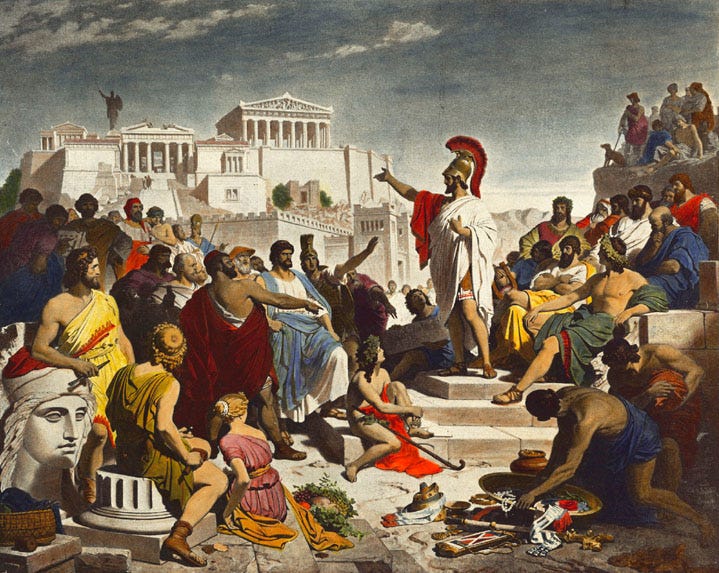
Pericles’ Funeral Oration, by Philipp Foltz (1852)
Political commentators were moved to compare the much-lauded speech given this week by Canada’s PM Mark Carney at the Davos World Economic Forum with the faous Funeral Oration of Pericles.
In 430 BC, Pericles, Athens’ leading citizen and general, delivered a speech to honour those who had fallen in battle in the first year of the Peloponnesian War (431-404 BC). Rather than a conventional speech of praise, he chose to describe the greatness of his city, Athens. Our knowledge of the speech comes solely from the report of the historian Thucydides, who might have been present.
Carney began his speech by quoting from a different speech narrated by Thucydides (the so-called Melian Dialogue) — ‘The strong can do what they can, and the weak must suffer what they must”. He went on to frame his argument around a quotation from the Czech statesman Václav Havel. This rhetorical device appears, ironically, to raise a telling contrast between the two speeches. In the course of his oration Pericles declares:
We shall not need to quote Homer for our praise, nor any poet whose words give momentary pleasure but fall short of the truth. We have compelled every land and sea to become a highway for our boldness; and everywhere we have left behind, for good or ill, imperishable monuments.
Such is the city for whose sake these men nobly fought and died, rejecting the thought that she might be taken from them; and everyone they leave behind should be prepared to take up the struggle on her behalf.
καὶ οὐδὲν προσδεόμενοι οὔτε Ὁμήρου ἐπαινέτου οὔτε ὅστις ἔπεσι μὲν τὸ αὐτίκα τέρψει, τῶν δ᾽ ἔργων τὴν ὑπόνοιαν ἡ ἀλήθεια βλάψει, ἀλλὰ πᾶσαν μὲν θάλασσαν καὶ γῆν ἐσβατὸν τῇ ἡμετέρᾳ τόλμῃ καταναγκάσαντες γενέσθαι, πανταχοῦ δὲ μνημεῖα κακῶν τε κἀγαθῶν ἀίδια ξυγκατοικίσαντες.
περὶ τοιαύτης οὖν πόλεως οἵδε τε γενναίως δικαιοῦντες μὴ ἀφαιρεθῆναι αὐτὴν μαχόμενοι ἐτελεύτησαν, καὶ τῶν λειπομένων πάντα τινὰ εἰκὸς ἐθέλειν ὑπὲρ αὐτῆς κάμνειν.
I have written at greater length about this, in an article published online: From Pericles to Davos.
Thank you!!
"A performance that is merely smooth and assured is not the same as one that generates its own authority and deploys carefully wrought language to move an audience."
The last decade summed up in a single sentence. Bravo.