
Translating the Odyssey
The rhythm of The Man

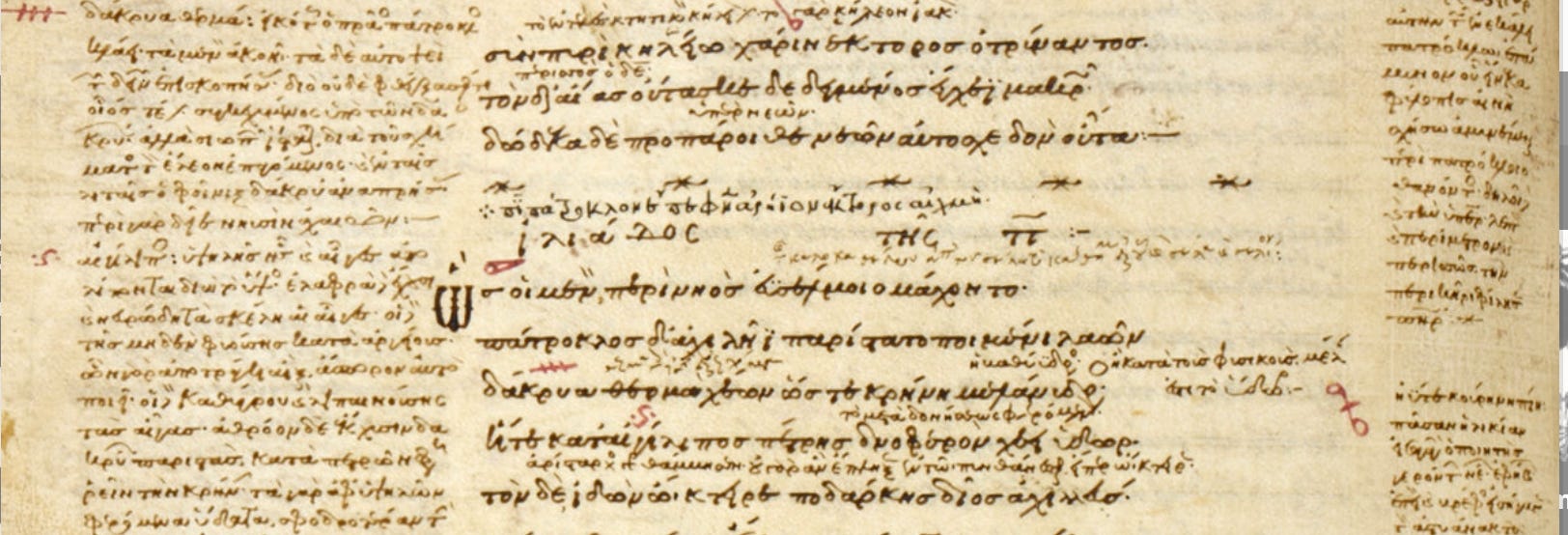
Homer’s Odyssey begins with the word andra, man. It is all about Odysseus - that man. How is one to translate it both faithfully and poetically, while making it as accessible and immediate as it is to those who read it in Greek?
In a recent piece I wrote about the difficulty of making a screen film of the epic (as Christopher Nolan is currently doing) I quoted the opening lines, and thought I should do so in my own translation. The most ready rhythm for doing so turned out to be an iambic heptameter, that is seven iambs (u -) in sequence. It is long enough to translate each line without missing the detail of the Greek (as the iambic pentameter so skilfully used by Emily Wilson in her translation must often do). And it comes close to capturing the feel, though not the rhythm, of the original hexameter line in Greek.
The epithet applied to Odysseus in the first line is polytropos, literally ‘much turning’. It connotes both physically “well travelled” and mentally “versatile”. Lattimore translates it ‘Man of many ways’ which is perhaps a bit obscure. The opening sentence then continues for a full 9 verses! Of the various versions I worked on (translators are notorious for wanting to make constant adjustments) I currently prefer this one:
That man of many twists and turns, Muse, tell of him, who far
went wandering when he had sacked Troy’s sacred citadel,
who many cities saw, and many thoughts of men discerned,
and many agonies endured within his heart at sea,
protecting his own life and his companions’ safe return;                               5
he could not save his comrades, though, however hard he strove,
since they were, through their own unthinking foolishness, destroyed –
poor fools, they ate the cattle of great Helios, the sun,
who there and then removed from them all hope of coming home...
Now tell us, Zeus-born Muse, the tale, beginning where you choose.          10
ἄνδρα μοι ἔννεπε, Μοῦσα, πολύτροπον, ὃς μάλα πολλὰ
πλάγχθη, ἐπεὶ Τροίης ἱερὸν πτολίεθρον ἔπερσεν,
πολλῶν δ᾽ ἀνθρώπων ἴδεν ἄστεα καὶ νόον ἔγνω,
πολλὰ δ᾽ ὅ γ᾽ ἐν πόντῳ πάθεν ἄλγεα ὃν κατὰ θυμόν,
ἀρνύμενος ἥν τε ψυχὴν καὶ νόστον ἑταίρων·                             5
ἀλλ᾽ οὐδ᾽ ὣς ἑτάρους ἐρρύσατο, ἱέμενός περ,
αὐτῶν γὰρ σφετέρῃσιν ἀτασθαλίῃσιν ὄλοντο,
νήπιοι, οἳ κατὰ βοῦς Ὑπερίονος Ἠελίοιο
ἤσθιον, αὐτὰρ ὁ τοῖσιν ἀφείλετο νόστιμον ἦμαρ.
τῶν ἁμόθεν γε, θεά, θύγατερ Διός, εἰπὲ καὶ ἡμῖν.                     10
There’s a marvellous passage in Book 1 when Penelope hears the bard Phemius singing to the suitors Returns of the Heroes and tries to stop him - only for her son Telemachus to jump in and support the bard’s choice to sing what he will…
Keep reading with a 7-day free trial
Subscribe to Armand’s Substack: Little Latin and More Greek to keep reading this post and get 7 days of free access to the full post archives.